
Many small business owners, entrepreneurs, and self-employed professionals in Canada need to renew their business insurance policies at the start of or early in the new year.
That renewal date is an ideal checkpoint to review your existing insurance coverage, look at how your operations may have changed in the past 12 months, and consider what may change in the months ahead.
It’s recommended that you review your business insurance coverage at least once a year. Doing so helps prevent your business from being:
- Underinsured: not having adequate coverage for the risks your company faces.
- Overinsured: paying for coverages in your policy that you no longer need.
Before renewing a policy, and after reviewing your coverage, it’s worthwhile to ask an insurance broker a few questions to ensure you’ve got the protection your company needs and that your policy still reflects your current operations.


Related Posts





Categories
Here are 10 questions to ask before renewing a business insurance policy in Canada:
1. Does my current policy cover all my business’s risks in Canada?
Your business insurance policy should cover the main risks your company faces today – not just when you first bought the policy. Before renewing, confirm your coverage still reflects your current business operations.
Business operations typically evolve. Ensuring your current commercial insurance policy still aligns with how your business operates is essential before renewing coverage.
Consider how your operations may have changed in the last year. For instance:
- Are you providing new products or services?
- Has your business property been renovated?
- Did you move to a new location or open an additional location?
- Did you purchase new equipment or vehicles?
You should notify your broker if these and other changes happened in the preceding year or if you will be making changes in the weeks and months ahead.
In some instances, you may need to add new coverages to your overall policy to account for new services, operational changes, or newly purchased equipment or inventory.
2. Are the coverage limits in my existing policy still adequate?
Coverage limits are the maximum amounts your insurer will pay for a covered claim. If your limits are too low, a single large claim could exceed them and leave your business paying the rest out of pocket.
Liability claims, such as third-party bodily injury or property damage claims, can sometimes exceed basic policy coverage limits. If they do, and your coverage has been exhausted, it can expose your business to paying for losses or damages yourself.
It may be necessary to increase your policy’s coverage limits or add umbrella insurance – an extension of the protection to your existing liability coverage limits. It acts as an extra layer of security when liability claims go beyond standard policy limits.
3. Is my business property covered for extreme weather events and natural disasters in my region of Canada?
Commercial property insurance is vital to cover your business property, contents, and inventory from damages and losses caused by fire, water, natural disasters, vandalism, and theft.
However, some commercial property policies may exclude coverage for specific perils, such as earthquakes or overland floods. Almost all insurance policies feature exclusions – provisions that remove coverage for certain risks, hazards, or events and outline what is not covered by your policy.
According to the Insurance Bureau of Canada (IBC), our country has seen a steady increase in the frequency of severe weather, including floods, and extreme water, ice, hail and wind events over the past four decades. That has translated to a steep rise in insured catastrophic losses.
For example, four severe weather events in July and August 2024 reached over $7 billion in losses, and more than 250,000 claims, which is 50% more than Canadian insurers typically receive in an entire year. In total, insured losses from severe weather in 2024 are estimated at over $1.8 billion in commercial insured losses, IBC said.
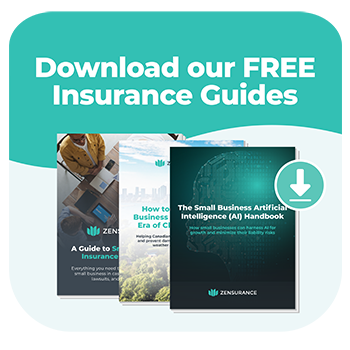
Our free, downloadable insurance guide, “How to Protect Your Business Property in the Era of Climate Change”, offers guidance and tips for minimizing damage to your commercial property.
4. How can I reduce my business insurance premium without compromising coverage?
Keeping a tight lid on your business’s expenditures is always a necessity. Still, you want to avoid leaving your finances exposed by buying an insurance policy that doesn’t adequately cover the liability risks you face.
It’s also worthwhile to be sure you’re not buying coverage for products or services you don’t provide presently.
There may be ways to lower your annual business insurance premium without reducing coverage, such as:
- Choosing higher deductibles (if you can comfortably afford them in the event of a claim).
- Bundling coverages (buying more than one type of coverage from the same insurer).
- Purchasing a business owner’s policy (BOP) that bundles multiple coverages in one package.
Ask a Zensurance broker to walk you through different options to balance savings with protection.
5. Does my policy include coverage for cyber threats and data breaches?
Every small business owner and independent professional in Canada should consider the cybersecurity risks and threats they face, regardless of their industry. Cyber insurance is becoming essential for many Canadian businesses.
An online Zensurance survey of 1,000 Canadian small business owners in September 2025 found more than half (53%) had already experienced an attack. Among those targeted:
- 46% faced phishing attacks
- 23% experienced malware
- 19% were victims of fraudulent transfers
- 6% suffered ransomware attacks
- 6% reported distributed denial-of-service (DDoS) disruptions
Those numbers should encourage your company to improve its cybersecurity defences and awareness. They should also prompt you to ask if your policy covers your business if it suffers a cyber-attack or data breach that exposes confidential data and disrupts your operations.
Your policy may need two types of cyber insurance coverages:
- Cyber liability insurance to cover your legal costs and damages following an attack, such as paying for the restoration of compromised software systems, notification costs, and crisis management.
- Cybercrime insurance to cover the loss of funds due to cybercrime from a wide range of attacks, including phishing attacks, ransomware attacks, and social engineering fraud.
Ask a Zensurance broker if your policy includes these coverages. If it doesn’t, it’s worthwhile to consider adding them.
6. Does my policy include business interruption coverage?
Business interruption insurance is designed to replace lost income and help cover ongoing expenses if your business has to close temporarily after an insurable loss.
If you have commercial property insurance, you may already have business interruption insurance as an endorsement. Check your policy documents or ask your broker to confirm.
Business interruption insurance is designed to cover your company’s income losses and overhead expenses, such as employee payroll, utility bills, loan payments, and rent, following an insurable loss (for example, a fire that forces you to close temporarily for repairs).
If it’s not included with your commercial property coverage, ask a Zensurance broker to include it and explain your options. However, you must have commercial property insurance to qualify for business interruption coverage.
7. Am I covered if a customer or vendor sues me?
Legal disputes can quickly become messy (and expensive). Disagreements, misinterpretations, and disputes with customers or third-party vendors over services or contracts can lead to costly litigation.
Find out if your liability policy includes coverage for legal fees and settlements involving customer or vendor disputes. For example, professional liability insurance – also known as errors and omissions (E&O) insurance – is necessary for service-based organizations, and it typically includes coverage for legal disputes related to professional services, advice, or negligence.
8. What is my policy’s deductible, and should it be adjusted?
Some insurance policies have deductibles, including general liability insurance, commercial property insurance, commercial auto insurance, and professional liability insurance.
A deductible is the amount a policyholder must pay for damage or loss when filing a claim before an insurer pays out. You can choose how high or low the deductibles in your policy are – typically, they’re $500 or $1,000. While a higher deductible can help keep an annual premium low, you should ensure you have the funds available to pay a deductible if you do need to file a claim.
Know your policy’s deductibles and ask a Zensurance broker if it’s necessary to adjust them.
9. What options are available to enhance my commercial auto insurance protection?
If your business owns one or more business vehicles, you’ll need commercial auto insurance to protect them from damages.
Personal auto insurance, or private-passenger auto insurance, covers vehicles for personal use. Commercial auto insurance covers vehicles used for business purposes.
A standard or basic commercial auto policy in Canada usually features four primary coverages:
- Third-party liability to cover another motorist’s medical expenses or property damage following a collision deemed to be your fault.
- Accident benefits cover your medical expenses if you’re injured in an accident, regardless of who’s at fault.
- Uninsured auto to pay for damages to your business vehicle if you’re in an accident with an uninsured driver or if your vehicle is damaged in a hit-and-run.
- Direct compensation-property damage (DCPD) coverage to file a claim directly with your insurer following an accident you’re not at fault for to repair your vehicle.
These standard coverages and their mandatory coverage limits may be insufficient. Ask a Zensurance broker to explain the coverage limits, and consider adding optional coverages to the policy to enhance your protection. Common optional coverages many business vehicle owners add to their policies are:
- Collision or upset insurance to pay for damages to your vehicle following a collision with another vehicle, a stationary object, or if it rolls over in a crash, regardless of who’s at fault for the accident.
- Comprehensive insurance to cover damages caused by severe weather, natural disasters, vandalism, or theft.
- All-perils auto insurance is a combination of collision and comprehensive coverages.
10. What factors cause business insurance premiums to increase upon renewal?
Many factors influence the price of insurance premiums, and while some are beyond any business owner’s control, others are. Among those factors are:
- Your insurance claim history – if you filed a claim in the previous year, it can lead to a premium increase.
- Changes to business operations – expanded operations, new services and products, more employees, and higher annual revenues may raise premiums.
- Inflation – when inflation rises, it increases the cost of rebuilding materials, repairs, medical expenses, and legal settlements for claims.
- Market conditions – if insurers are seeing increasing claims and higher payouts due to natural disasters and economic shifts, premiums may rise.
- Regulatory or legal changes – when laws or industry regulations change, it can trigger higher premiums if professions or industries require higher coverage limits in insurance policies.
- A lapse in coverage – if your policy lapses due to non-payment of a premium or if an insurer cancels your policy, it can make purchasing a new one more expensive since insurers may regard your business as having more risk.
Is It Easy to Switch Insurers or Insurance Brokers?
Switching insurance providers or moving to Zensurance from a different brokerage is not uncommon or complicated.
Furthermore, changing insurers when your policy is due for renewal and before it expires may save you money by getting the coverage you need at a better rate.
Zensurance can help you make the switch quickly and easily.
How to Get the Right Protection for Your Small Business
Zensurance is Canada’s leading small business insurance brokerage. We help protect hundreds of thousands of small business owners, independent professionals, entrepreneurs, and startups across the country with comprehensive, customized business insurance.
Complete our online application for a free quote in under five minutes.
Our team of friendly, knowledgeable brokers will shop our partner network of over 50 insurers to find the policy that suits your business and tailor it to meet your needs and budget.
– Updated January 12, 2026.
Recent Posts

Franchise Insurance Requirements in Canada: What Your Franchise Agreement Requires
Your franchise agreement spells out the coverage you must carry before opening day. Here’s what each clause means, what it costs in Canada, and how to get your certificate in hand fast.

What Is Commercial General Liability (CGL) Insurance? A Guide for Canadian Small Businesses
A customer trips at your front door. A job goes sideways and floods a client's basement. Here's how commercial general liability (CGL) insurance protects your business from claims like these, what it costs, and how to get covered in minutes.

Workers’ Compensation vs Employers’ Liability Insurance: What’s the Difference?
Workers' comp and employers' liability insurance both deal with workplace injuries, but they're not interchangeable. Here's how each one works, who needs it, and why many Canadian small businesses carry both.
Sign Up for ZenMail
"*" indicates required fields